
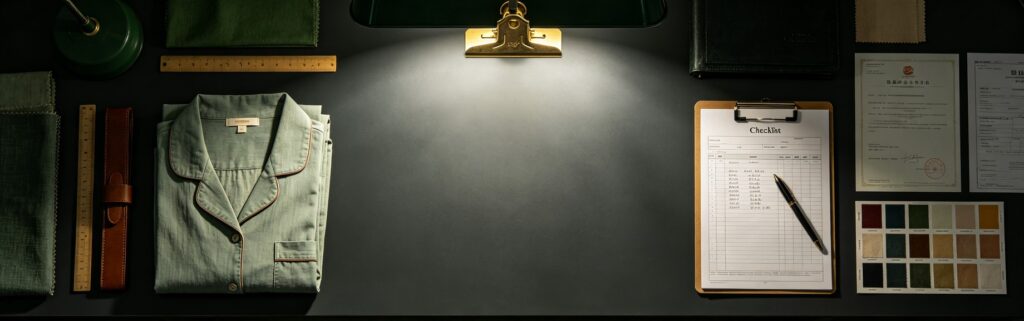
Every horror story we hear from brands who came to us after a bad first supplier follows the same arc: the deposit was wired before the questions were asked. So here are the questions — the full 15-point checklist we would use if we were vetting a sleepwear factory ourselves, including the ones that would make us squirm if a buyer asked them coldly.
Run the list before money moves. Each point takes minutes; together they filter out the majority of bad outcomes — mismatched sets, sample-versus-bulk surprises, ghosted timelines — before they can happen.
Identity & Paper (Points 1–4)
1. Legal entity and export record. Ask for the registered company name and check it against the export documentation they propose to use. A trading company posing as a factory is not automatically bad — but a supplier lying about which one they are, is.
2. Certificates with checkable numbers. OEKO-TEX, GRS, BSCI, ISO — every real certificate has a number verifiable at the issuer’s public database (OEKO-TEX Label Check, Textile Exchange). A legitimate factory sends the numbers within hours. Blurry logo screenshots are a fail.
3. A live video walk of the floor. Not a produced video — a WhatsApp call where someone walks from cutting to sewing to packing on request. Five minutes of unedited footage beats any brochure.
4. Client references in your category. For sleepwear specifically: ask what share of their volume is pajama sets versus general apparel. Sets have set-specific failure modes (next section) that a t-shirt line never trains a factory to handle.
Production Truth (Points 5–9)
5. Same-line sampling. “Is the proto sample sewn by the same operators who will run bulk?” If sampling happens in a separate sample room, the sample you approve is a promise the production line never made. This single question predicts sample-versus-bulk disappointment better than any other.
6. Dye lot procedure for sets. The most common failure in pajama production is a top and bottom that read as different shades under retail lighting. The correct answer mentions single dye lot sourcing, a dye lot certificate before cutting, and lab dips checked against the approved standard. If the answer is “our color is very accurate,” keep looking — a serious pajama manufacturer treats set coordination as a production constraint with a written procedure, not a talent.
7. Pre-washing knits. Knit fabric shrinks on first wash. Factories either pre-wash before cutting (adds a day, kills the problem) or ship the shrinkage to your customers. Ask which.
8. In-line QC, not just final inspection. Checkpoints after cutting, mid-production, and post-finishing catch problems while they are correctable. A factory that only inspects at the end can only tell you bad news, not prevent it.
9. Realistic lead times. 25–40 days for bulk sleepwear production from sample approval is honest. Anyone promising bulk in 10 days is either quoting stock garments or quoting fiction. Suspiciously fast is as bad a sign as suspiciously cheap.
Money & Risk (Points 10–13)
10. Standard deposit structure. 30% deposit, balance against shipping documents is the normal shape for made-to-order apparel. 100% upfront from a supplier you have never worked with moves all risk to you.
11. A written defect remedy. The industry-standard inspection level for branded apparel is AQL 2.5. The question is what happens when a batch exceeds it. Get the answer in writing — the strong version is “we remake or refund.” A factory that will not commit on paper is telling you what happens when things go wrong.
12. Sample fee that credits back. Charging for samples is normal and healthy (free samples get paid for somewhere). The fair structure credits the fee against your first bulk order — which also signals the factory is pricing for a relationship, not a transaction.
13. MOQ math that is not a trap. Confirm whether the minimum is per style, per color, or total — and whether packaging carries its own separate minimum (rigid gift boxes typically require 200 units for tooling reasons; honest factories say so upfront instead of surprising you at invoice).
Communication & Compliance (Points 14–15)
14. Response rhythm during courtship. Suppliers are never more attentive than before the deposit. If replies take three days now, they will take a week during production. A stated response commitment (measured in hours, not days) that they actually keep during quoting is the test.
15. Compliance fluency for your market. For US-bound sleepwear, ask one question: “What are the CPSC options for children’s sleepwear?” A factory serving that market answers immediately (flame-resistant fabric, or tight-fitting with required labeling, 16 CFR 1615/1616). A blank pause means you will be the one educating your supplier — at your own risk.
How to Use This List Without Being Annoying
You do not need to interrogate anyone across fifteen bullet points in one email. Spread them across the natural quoting conversation: identity and certificates in the first exchange, production questions when discussing your sample, money questions at the pro-forma stage. Any low MOQ clothing manufacturer worth a 100-piece test order will answer all fifteen without friction — we would, and we notice that the buyers who ask them are also the ones who reorder, because nothing about the collaboration surprises them later.
Score it simply: 13+ clean answers, proceed. 10–12, proceed with a smaller test order. Below 10, the discount is not worth it.
See How We Answer These 15FAQ: Vetting a Sleepwear Supplier
“Is the sample sewn on the same line, by the same operators, as bulk production?” Sample-versus-bulk mismatch is the most expensive common failure in apparel sourcing, and this question exposes the structural cause in one sentence. The second most important: how set color coordination is procedurally guaranteed (single dye lot with certificate).
30% deposit with balance against shipping documents is standard for made-to-order apparel. Small first orders sometimes run 100/50. Full payment upfront to an unverified supplier concentrates all risk on the buyer and is a legitimate reason to walk away.
AQL (Acceptable Quality Limit) 2.5 is the standard inspection sampling level for branded apparel — roughly, the defect tolerance a batch must stay under during statistical inspection. It matters because it turns ‘good quality’ from a feeling into a checkable, third-party-auditable number. The follow-up question is what remedy applies when a batch exceeds it: the strong answer is remake or refund, in writing.
Every major certification has a public verification database: OEKO-TEX Label Check for Standard 100, the Textile Exchange database for GRS scope certificates. Ask for the certificate number, paste it into the issuer’s checker, and confirm the holder name and validity dates match. It takes two minutes and instantly filters suppliers who borrow logos they have not earned.
Put the Checklist to Work
The fastest way to evaluate any supplier — including us — is to send the same inquiry to two or three factories and run the fifteen points against the replies. If sleepwear is your category, our pajamas wholesale program is set up to survive exactly this scrutiny.
✅ Low MOQ — from 100 pcs per colour / design
✅ 3-Point QC · AQL 2.5 — defects above tolerance remade or refunded
✅ Sample turnaround in 7–10 days, fee credited above 100 pcs
✅ Verifiable certs — OEKO-TEX SH025 206558 · GRS TE-00110085
⏱️ We reply to every inquiry within 8–12 hours.
Request a Quote