
Almost every cycling brand we talk to opens with the same question, just phrased differently: “Do I put my logo on something that already exists, or do I have you build my kit from scratch?” That is the white-label-versus-in-house decision, and for cycling apparel it carries more weight than it does for a plain tee — because a cycling kit is a technical garment, and the two production models handle “technical” very differently.
As a cycling clothing manufacturer that runs in-house cut-and-sew production, we have an obvious stake in this. But the honest answer is that both models are right — for different brands at different stages. Here is how we explain the trade-off to the cyclists and founders who ask.
What white label actually means for a cycling brand
White label means the garment already exists. A factory has pre-developed a jersey, a bib short, a jacket — pattern graded, fit-tested, sewn, inspected — and sells that same base to many brands. You choose from what is on the shelf, add your logo and sublimation print, pick your labels, and you are in market.
The appeal is speed and low risk. You skip pattern development, fabric trials and sample rounds, so entry cost is lighter and lead time is shorter. For a new club kit, an event one-off, or a founder testing whether anyone will buy the brand at all, that is often exactly the right call. You are buying a known-good product and putting your name on it.
The limit is that the garment is not yours. The fit block, the chamois, the fabric weight, the panel layout — those were decided for everyone, not for your rider. If your differentiator is “a better-fitting bib” or “a specific aero cut,” white label cannot deliver it, because you do not control the thing that would make it true.
What in-house cut-and-sew production gives you
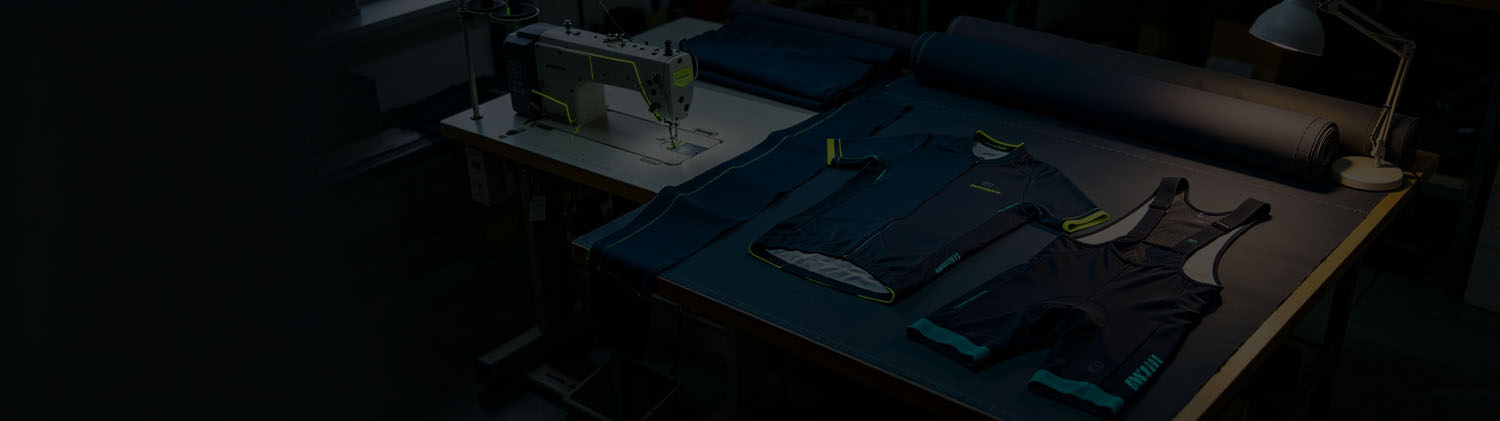
In-house (full OEM cut and sew) means the garment is built to your spec. You bring a tech pack or a reference kit and a fit intent; the factory drafts or adapts the pattern, sources the fabric to your target weight and stretch, sews a proto sample, and you approve the real thing before bulk. Every panel, seam and trim is a decision you get to make.
That control is what costs more — in MOQ, in sample rounds, in lead time. You are paying for development, not just production. The pay-off is a kit that is actually yours: a fit block competitors cannot buy off a shelf, a chamois matched to your ride time, an aero panel layout you specced. Once a brand has proven demand, this is usually where it moves.
Why this choice matters more in cycling than in most apparel
With a cotton tee, white label versus custom is mostly about branding and fit preference. With cycling apparel it is about whether the garment performs, because every piece is doing a technical job:
- Jerseys have to move heat and sweat out fast while holding shape at speed — that is fabric choice and panel construction, not just a print.
- Bib shorts live or die on the chamois and the balance of compression versus support. A generic pad under a three-hour ride is where returns come from.
- Skinsuits are about drag: seam placement and fabric tension either reduce it or they don’t, and a shelf product was not optimised for your rider’s position.
- Winter kit needs insulation without bulk — a construction problem you can only solve if you control the construction.
This is the real reason the decision is harder for cycling than for casualwear: the parts of the garment that white label freezes are exactly the parts that determine whether a serious cyclist keeps wearing it. So the question is less “which is cheaper” and more “does my brand’s promise live in a part of the garment I need to control?”
White label vs in-house: a side-by-side
| White label | In-house cut & sew | |
|---|---|---|
| What you control | Logo, print, labels, packaging | Fit, fabric, chamois, panels, trims — everything |
| Speed to market | Fast — product already exists | Slower — pattern & sampling first |
| Entry cost & MOQ | Lower | Higher (you pay for development) |
| Technical fit for cycling | Generic — decided for everyone | Tuned to your rider & use case |
| Best for | Club kits, events, first market test | Brands with proven demand & a fit/aero differentiator |
How to actually decide
Match the model to your stage, not to what sounds more premium. If you are testing whether the brand sells, or fulfilling a one-off club or event order, start white label — prove demand before you pay for development. If riders already buy from you and your growth depends on a kit that fits or performs better than the shelf option, move to in-house so the differentiator is real.
Plenty of brands run both: white label for quick club and event runs, in-house for the flagship race kit. What matters is being honest about where your brand’s promise actually lives, because that is where choosing a cycling clothing manufacturer with in-house control either pays off or doesn’t. If it lives in a logo, white label is enough. If it lives in the fit, the chamois or the aero, you need to own the build — which is what our activewear manufacturer cut-and-sew program is for, and it sits inside our wider low MOQ clothing manufacturer service from 100 pieces per design.
See Our Activewear Cut-and-Sew ProgramFAQ
For a brand still testing demand, white label is usually better: you skip pattern development and sampling, keep MOQ and cost low, and get to market fast on a proven garment. Move to in-house cut-and-sew once demand is proven and your differentiator depends on fit, chamois or aero construction you need to control.
Because cycling garments are technical. The parts white label freezes – fabric behaviour in a jersey, the chamois and compression in bib shorts, seam placement in a skinsuit, insulation in winter kit – are exactly the parts that decide whether a serious cyclist keeps wearing the product. In casualwear those parts barely matter; in cycling they are the product.
Yes, and many brands do. Start white label to validate the market with club kits or event runs, then move your flagship kit to in-house production once you have demand and a clear fit or performance differentiator. Some brands keep running both models in parallel.
Ask three things before you commit. First, do they run production in-house or subcontract it – that decides who is accountable for fit and quality. Second, what is the real MOQ and does it fit your stage. Third, can they handle the technical parts a cycling kit needs: fabric that manages heat and moisture, a chamois matched to ride time, and clean seam construction. A cycling clothing manufacturer that controls its own cut-and-sew line can answer all three without deflecting.
Our cut-and-sew knit MOQ starts at 100 pieces per design, with sample lead time of 7-10 days and bulk production of 25-40 days after approval. Cycling kit that uses woven or bonded technical panels may carry a higher minimum, which we confirm at the quoting stage.