100 pcs
Per colour / design — sizes mixed freely
from $5.50/pc
FOB starting price
7–10 days
Sample turnaround
DDP Door-to-Door
Duties-paid delivery — no customs hassle for first-time importers
Reorder 10–15 Days
Restock fast, no 30-day wait when it sells
30/70 Escrow
30% starts production, 70% only before shipment — after your goods are ready to go
8–12hr Reply
We reply to every inquiry within 8–12 hours
Sample = Standard
Bulk that drifts from your approved sample gets remade, not shipped


What 'Loungewear' Actually Means for Production
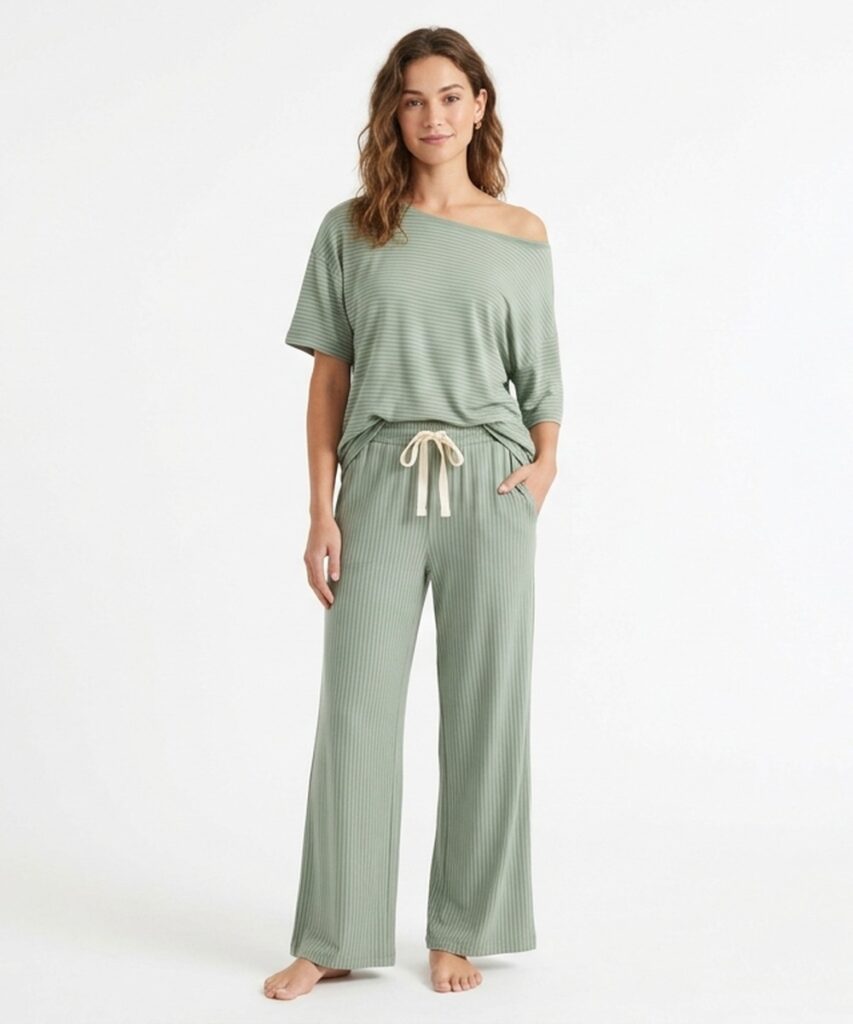
Loungewear is not a fabric category. It is a silhouette and end-use category that gets produced across several different fabric constructions — and the right one depends on exactly what the garment needs to do. A factory that only runs one fabric type cannot honestly serve the full loungewear range. And if loungewear is one slice of a wider women’s range — sleepwear, leggings, tops — our women’s clothing manufacturer page covers running the whole line at one factory.
The styles that make up most loungewear programs: joggers with elasticated or drawcord waistbands and cuffed or open-hem legs; matching sets pairing a wide-body crew or hoodie with a corresponding jogger or short — where the dye-lot coordination between top and bottom is the central production challenge; lounge shorts in either knit or woven; and sleep-adjacent styles like oversized long-sleeve tees, lightweight zip-ups, and wide-leg knit pants that sit at the loungewear-sleepwear boundary without being traditional woven pajamas.
French terry (280–320gsm), modal jersey (160–200gsm), waffle knit (220–260gsm), brushed fleece (300–340gsm), rib knit for trim and waistband panels.
Top and bottom must be cut from the same dye lot — not the same color reference, the same physical lot. A half-shade difference visible under natural light will fail any review for a quality brand.
Fabric weight is the variable that most sourcing conversations skip. A 280gsm French terry jogger and a 320gsm French terry jogger look identical on paper but behave differently: the 280gsm drapes and recovers faster, making it more comfortable for warm-weather wear and gifting. The 320gsm holds structure better through washing and is preferred by buyers positioning their range at a premium price point. Both are standard in our production; the question is which serves your end customer.
If you are sourcing as part of a broader apparel program, our low MOQ clothing manufacturing overview covers how loungewear orders fit alongside sweatshirts, tees, and other knit categories in a combined production schedule.
Waffle knit is the fabric that consistently surprises buyers — not because the output is unexpected, but because the tooling discussion is more involved than they anticipate. Waffle knit requires a dedicated jacquard knitting setup and the GSM varies depending on the waffle cell size. When a buyer specifies “waffle knit lounge set” without a GSM or cell spec, we ask before we sample, because the visual weight and hand-feel difference between a shallow 4mm cell at 200gsm and a deep 6mm cell at 260gsm is significant enough to affect the finished product’s market positioning.
Private Label Loungewear: What's Included
Private label on a loungewear order means more touch points than a basic T-shirt. A jogger alone has four standard label positions — neck, care/size, waistband interior, and optional hem. A matching set doubles most of those. The table below shows what each element involves, whether it is standard on all orders or subject to a separate MOQ, and what the setup process looks like.
Standard >200 pcs
Standard >200 pcs
MOQ Applies
MOQ Applies
Standard >200 pcs
Box: 200 pcs min
First sample orders are sewn with a plain white care label — no brand label, no custom drawcord. This lets you evaluate fit, construction, and fabric before committing to label tooling costs. Label tooling setup is charged once per label design and amortized across the full run; we do not re-charge it on reorders of the same design unless you revise the artwork.
For buyers building out a full private label program across multiple categories, see our private label clothing manufacturing page, which covers how label programs work across mixed-style orders.
Our Loungewear Production Process
Five stages from inquiry to shipment. The timeline is predictable except at Stage 3 — sample review — where the variation is entirely in the buyer’s hands and where most delays actually originate.
1. Brief & Tech Pack Review
You send a brief — reference images, fabric preference, construction notes, size range, target price — or a full tech pack. We confirm producibility, flag any spec conflicts (e.g., a GSM that doesn’t support the seam construction you’ve drawn), and issue a pre-production cost estimate within 2 business days. If a tech pack is incomplete, we send a spec checklist rather than guessing at your intent.
2. Fabric Sourcing & Sample Development
Stock fabric orders move to sewing immediately. Custom fabric — non-stock GSM, color, or blend — requires a dye lot booking, which adds 8–12 days. Sample development runs 7–10 days from fabric availability. First samples are sewn in a single size (typically M or L); full size set samples are available at an additional cost and are standard for buyers who intend to order immediately after approval.
3. Sample Review & Approval — Where Timelines Actually Slip
This is the honest part of the process. Factories quote “2 revision rounds” as a standard; in practice, the number of rounds is whatever it takes to get to approval, and the timeline is determined by how quickly the buyer can review and respond, not by how quickly we can re-sew.
The most common sources of delay in our sample review stage: (1) Fit comments that arrive 10–14 days after sample receipt because the buyer’s team is reviewing by committee. (2) Revision requests that change the construction spec — not just fit adjustments — which require a re-draft of the pattern rather than a sewing correction. (3) Color approval done under office fluorescent lighting when the product is intended for natural-light retail presentation.
Our recommendation: review samples within 7 days of receipt, consolidate all feedback into a single annotated document before sending, and evaluate color against the light source your end customer will use. One focused revision round is faster than three polite ones.
For matching sets, color approval must cover the top and bottom under the same lighting at the same time. Approving the hoodie in one review cycle and the jogger two weeks later — against a different reference or in different lighting — is the most common reason a “matching” set arrives with a visible shade difference. We flag this before sampling, not after.
4. Bulk Production & Quality Control
Production runs 25–35 days after deposit receipt (30% deposit standard). Inline QC is conducted at cutting and at end-of-sewing-line stages. Final inspection follows AQL 2.5 for major defects and AQL 4.0 for minor defects. Inspection reports are available on request; third-party inspection (SGS, Bureau Veritas) can be coordinated at buyer cost with 3 days’ notice before final inspection date.
5. Export, Shipping & Documentation
We ship FOB Shanghai or Ningbo or CIF to any major port. Documentation provided: commercial invoice, packing list, certificate of origin, and any product testing reports required for your market (OEKO-TEX, Prop 65, REACH on request). For buyers new to direct factory importing, we can refer you to freight forwarders our other US and EU clients use — we do not mark up freight or act as your customs broker.
Fabric Options for Loungewear
The five constructions below cover 90% of the loungewear programs we produce. All are available from stock in core colors; custom GSM, fiber blends, and colors outside the stock range are sourceable with a minimum dye lot — noted per fabric.
| Fabric | Composition | GSM | Hand-feel | Best for |
|---|---|---|---|---|
| French Terry | 80% cotton / 20% polyester or 100% cotton |
280–320gsm | Smooth face, looped reverse; medium-heavy body with clean drape | Joggers, hoodies, matching sets; the workhorse loungewear fabric across all price points |
| Modal Jersey | 95% modal / 5% elastane or 50% modal / 50% cotton |
160–210gsm | Exceptionally soft, silky surface, fluid drape; lighter than cotton jersey at the same GSM | Lounge shorts, sleep-adjacent tees, wide-leg pants where a lightweight drape is required |
| Waffle Knit | 100% cotton or 95% cotton / 5% elastane |
200–260gsm | Textured raised grid; slightly crisper hand than French terry; less prone to pilling | Sets with a textural detail story; particularly strong for gifting programs and photogenic flat-lay presentation |
| Brushed Fleece | 65% cotton / 35% polyester or 80% cotton / 20% polyester |
300–340gsm | Soft brushed interior, structured exterior face; heaviest hand of the standard range | Autumn/winter loungewear, oversized styles, premium positioning where weight signals quality |
| Rib Knit | 95% cotton / 5% elastane | 240–280gsm | Defined vertical rib, high stretch recovery, form-following fit | Co-ord sets with a body-skimming silhouette; also used as trim panel for waistbands and cuffs across all other constructions |
Custom fiber blends, non-standard GSM, or colors outside our stock range require a minimum dye lot of 80–100kg. For most loungewear styles this maps to 120–200 finished garments depending on cut. Custom fabric adds 8–12 days to the pre-production timeline and is confirmed in writing before we proceed. We do not run custom fabric speculatively.
Fabric shrinkage almost never appears on an incoming tech pack, but it should. All loungewear fabric in our program is sanforized (mechanically pre-shrunk) before a single panel is cut — untreated cotton and cotton-blend knits typically shrink 3–5% after the first home wash, which shows up as a fit complaint weeks after your customer has already worn the garment once. Our sanforized fabric is held to 3% or less residual shrinkage on a standard cold-wash, tumble-dry-low cycle, and this is checked at final inspection alongside the AQL defect count. If your finished-garment measurements come from a tech pack, they should already assume this treatment — worth confirming with any factory that doesn’t mention it.
For buyers whose program also includes cut-and-sew styles in woven fabric, our cut and sew manufacturing page covers how woven and knit categories run on separate lines and how mixed-category orders are scheduled.
MOQ, Pricing, and Lead Time
The honest version: the unit cost difference between a 100-piece run and a 300-piece run on the same style is meaningful — roughly 22–28% lower at 300 pieces compared to 50, based on our current production cost structure. That gap narrows between 300 and 500 pieces. Beyond 500 pieces per style per color, the incremental saving is smaller and the main benefit shifts from unit cost to scheduling priority.
Matching sets are priced per piece, not per set. A 200-piece matching set order — 100 tops and 100 bottoms — is treated as two 100-piece style orders. The set coordination (same dye lot, same production window) does not add cost; it adds a scheduling constraint that we absorb internally.
| Order Tier | Unit Cost Position | Lead Time | Notes |
|---|---|---|---|
| 100–199 pcs | Higher unit cost ~28% above 300-pc rate |
28–38 days | Full private label available above 200 pcs; 100–199 pcs uses plain care label unless custom label volume is pre-purchased separately |
| 200–299 pcs | Mid-range — full private label economics start to work | 28–38 days | Custom woven label, hangtag, polybag included at this tier; drawcord and rib color customization subject to material minimums |
| 300–499 pcs | Strong unit economics ~22–25% below 100-pc rate |
28–35 days | Full custom program standard — all label positions, custom packaging; rush production (18–22 days) available at +15% |
| 500+ pcs | Best unit cost Scheduling priority |
25–32 days | Priority line allocation; custom fabric spec becomes cost-effective at this tier; dedicated account contact for reorder planning |
Buyers sourcing loungewear for resale rather than private label manufacture — finished goods in stock colors, standard sizing, no custom branding — should see our loungewear wholesale page for stock program pricing and minimum requirements.
Selected Client Projects
Names are withheld at the clients’ request. Everything below is from real production runs.
US Casualwear Brand — Flannel Loungewear & Pajamas
Full OEM/ODM for a US brand’s flannel pajama sets and knit loungewear: tech pack, sampling, cut and sew, woven labels, hangtags, printed polybags. It runs on our own GRS-certified flannel at 100 pieces a style, and they order several styles and colours together so testing a new drop doesn’t cost much. Samples in about 12 days, bulk in 30 to 45. Everything ships with valid eco-certification, which matters for how they pitch the brand.
Outcome: We’re now their main fall/winter loungewear supplier, with new styles each season.
Our Terms, In Writing
Most factories make you email three times to learn their MOQ. Here is everything, up front.
| Term | What we commit to |
|---|---|
| MOQ | 100 pieces per colour / design on fabric dyed to your colour — each colour needs its own dye run, so each colour carries its own 100. Sizes are mixed freely within those 100: no size multiplier, XS to XXL in one run. (Custom woven labels need 200 pcs per colorway — label looms carry fixed setup costs. Screen-printed labels work at lower runs.) |
| Pricing | From $5.50/pc FOB. We don’t publish one fixed unit price — fabric, weight, decoration, colourway count and packaging all move the number. Send us your style and target quantity and we quote every tier (100 / 300 / 500 / 1,000) in one email, so you can see exactly what scaling saves you before committing. |
| Sampling | Sample fee applies per style, itemized on your quote. |
| Bulk production | 28–38 days after sample approval, including fabric sourcing. |
| Reorders | 10–15 days. This is where working with the actual factory pays off. |
| Payment | 30% deposit, 70% before shipment. |
| Shipping | FOB Shanghai or Ningbo, or DDP door-to-door. We quote both, so you can compare true landed cost — not just the factory-gate price. Our factory is in Suzhou, Jiangsu; both ports are within a short inland haul. |
| Certifications | OEKO-TEX® Standard 100 and GRS 4.0. Certificates and our business licence sent on request. |
| Fabric Shrinkage | All loungewear fabric is sanforized (pre-shrunk) before cutting — residual shrinkage guaranteed 3% or less after a standard cold-wash, tumble-dry-low cycle. |
Why Buyers Trust Renrui Textile
10+ Years
You buy straight from our factory, not through a trading company.
From 100 pcs
100 per colour, and you split those 100 across sizes — we don’t multiply the minimum by size.
Fast Sampling
Real samples in days, not weeks, with the timeline written into the quote.
3-Point QC · AQL 2.5
Checked inline, again at 30% done, and before it ships. If defects exceed AQL 2.5, we remake or refund.
Certified Materials
OEKO-TEX® Standard 100, GRS 4.0, BSCI, ISO 9001
In-House Production
Cutting, sewing, decoration, and labeling all in one place.
Frequently Asked Questions
100 pieces per color per style. That means a jogger in stone grey, sized XS–XL, qualifies as a single 100-piece run. We do not multiply MOQ by the number of sizes in the ratio.
What we do enforce: if you want a custom-dyed fabric color outside our stock range, the dye lot minimum is 80–100kg of fabric — typically 120–150 finished joggers depending on weight. For buyers ordering both a top and a bottom as a matching set, the 100-piece MOQ applies per style, but both styles need to be dyed from the same fabric lot. In practice that means 200 pieces minimum across the set.
Same dye lot, cut and processed together — this is non-negotiable. The reason matching sets fail at some factories is that they run top and bottom fabric through separate dye batches, even in the same week, and accept a half-shade variation. Under retail lighting it is invisible. Under natural light or in photography it is obvious and will cost you returns.
Our process: top and bottom fabric is dyed in a single lot, staged together, and released to cutting as a combined work order. We do not split sets across production weeks. This adds scheduling complexity on our side, not yours. Color approval for sets must cover both pieces simultaneously and under consistent lighting — see the note in our production process section above.
Yes, and private label is standard — not an upgrade. Every order above 200 pieces per colorway includes custom woven neck label, hem label, hangtag, and polybag printed with your brand.
Below 200 pieces, the setup fees for label tooling are real and we will be direct about the math: a 100-piece run with full custom labeling adds roughly $0.24–$0.36 per unit in label costs, which some brands accept and others don’t. For first sample orders we use a plain white care label so you can evaluate fit and construction before committing to label tooling. We do not skip this step and then charge you later.
28–38 days from sample approval and deposit receipt. That range reflects one real variable: fabric. Stock fabric in our warehouse means the shorter end is achievable. Custom GSM, fiber blend, or a non-stock color adds 8–12 days for fabric sourcing and dye lot confirmation.
Rush production at 18–22 days is available for stock-fabric orders at a 15% surcharge, but we offer it selectively. Knit fabric behaves differently under time pressure than woven, and a rushed French terry program can produce seam stress or relaxation issues that are not visible at final inspection but manifest after the first wash. We are not willing to deliver that product and say nothing about it.
Both, but with a clear distinction. What we produce well on our knit lines: joggers, lounge shorts, matching sets, oversized long-sleeve tees, and lightweight hooded sets that sit at the loungewear-sleepwear boundary.
What requires a separate production conversation: woven pajama sets with notch collars and button plackets, and traditional robes with shawl collars. We do produce those, but not on the same lines as knit loungewear. If your range mixes woven pajamas and knit sets, we scope them separately rather than combine them into a single timeline. Mixing cut-and-sew woven and circular-knit production into a single delivery date is how lead times get missed — and we would rather tell you that upfront than absorb the consequence quietly.
Yes — every fabric construction in our loungewear program is sanforized (mechanically pre-shrunk) before a single panel is cut, and we hold it to 3% or less residual shrinkage on a standard cold-wash, tumble-dry-low cycle. This matters most if you are supplying your own tech pack: your finished garment measurements should already assume this treatment. If a factory doesn’t mention shrinkage treatment at all, ask — untreated cotton and cotton-blend knits typically shrink 3-5% after the first wash, which is a common source of post-delivery fit complaints that surface weeks after a garment has already been worn once.
Other Manufacturing & Sourcing Options
How small-brand production works across categories — MOQ structure, sampling process, and what 100-piece runs actually cost versus 300-piece runs.
Private Label Clothing Manufacturer
Full private label program details: label types, packaging options, artwork requirements, and how branding is handled across a multi-style order.
For buyers whose range includes woven styles alongside knit loungewear — how cut-and-sew and circular knit production run on separate lines and timelines.
Finished goods in stock colors without custom manufacturing — for buyers who want factory-direct wholesale pricing without a production program.
Request a Loungewear Production Quote
Why Request a Quote From Us
- ✅ Low MOQ — from 100 pcs per colour / design
- ✅ OEKO-TEX® Standard 100 & GRS 4.0 certified materials
- ✅ Full OEM / ODM — your design, labels & packaging
- ✅ Sample turnaround in 7–10 days
- ✅ Free fabric swatch pack on request
What to Include in Your Inquiry
- Styles & target quantity
- Material / fabric preference
- Target price & deadline
⏱️ We reply to every inquiry within 8–12 hours.
You can also reach us directly:
WhatsApp: +86 13372169755
E-mail: [email protected]