
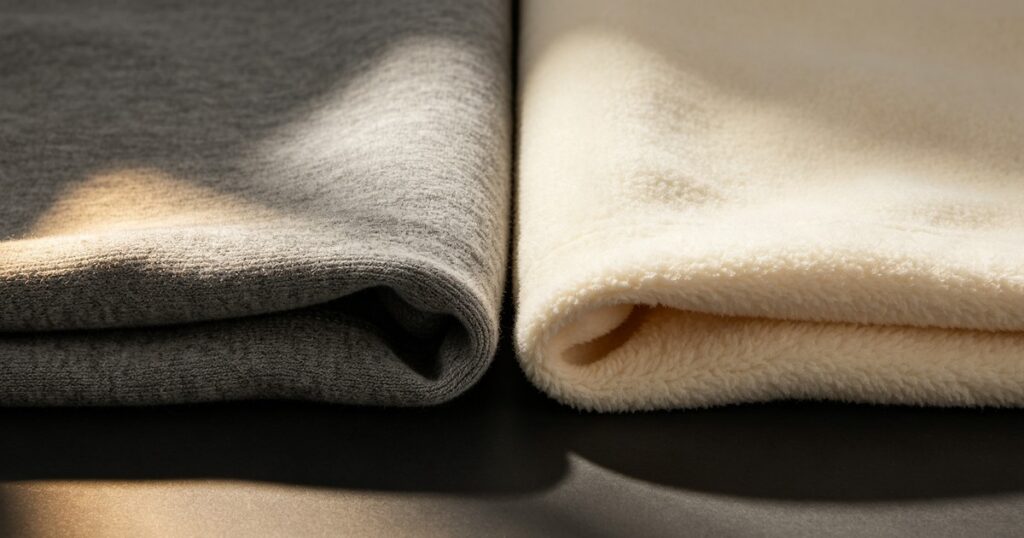
If you’re putting your first hoodie or jogger into production, the fabric-weight question is where the order quietly goes right or wrong — and it’s the one thing almost no one explains straight. Search “french terry vs fleece” and you’ll get a dozen blogs telling you french terry is “breathable” and fleece is “cozy,” then nudging you toward whatever they happen to sell. None of them tell you what each choice does to your cost, your MOQ, or your freight bill.
I’ve spent years on the factory side of exactly these garments — cutting and sewing hoodies, crewnecks and joggers in every weight from 240 to 500 gsm. So here’s the version with the numbers in it: what french terry and fleece actually are, what GSM to pick for which garment, and the cost and durability trade-offs the fabric blogs leave out.
What French Terry Actually Is (and What Fleece Is)
French terry is a knit fabric with a smooth face and small unbrushed loops on the inside — the same loop-back you see on a classic crewneck sweatshirt. Those loops trap a little air, so it’s warm without being bulky, it breathes, and it holds its shape. Because the surface is flat and stable, it takes print and embroidery cleanly. It’s the fabric most “premium heavyweight” streetwear is built on.
Fleece — specifically brushed-back or “sweatshirt” fleece — usually starts as french terry and then gets the inside brushed into a soft, fuzzy nap. That brushing is what makes fleece feel plusher and warmer at the same weight. The trade-off: the brushed surface is what pills over time, and it gives you a slightly softer, less crisp print surface.
So they’re cousins, not opposites. A lot of “fleece” hoodies are brushed french terry. The real decision isn’t a brand name — it’s brushed or not, and how heavy.
French Terry vs Fleece: The Honest Comparison
| French Terry (unbrushed) | Brushed Fleece | |
|---|---|---|
| Inside surface | Small loops, structured | Brushed, soft nap |
| Warmth (same GSM) | Moderate, breathable | Warmer, cozier |
| Drape & structure | Holds a boxy, structured shape | Softer drape, less structure |
| Print / embroidery | Crisp, stable surface | Good, slightly softer edges |
| Pilling over time | Lower — no brushed nap to pill | Higher at the brushed surface |
| Best for | Structured streetwear, year-round hoodies, joggers that keep their shape | Cozy loungewear, winter hoodies, ultra-soft feel |
Quick rule from the cutting floor: if you want a hoodie or jogger that photographs structured and holds its silhouette drop after drop, french terry. If you want the softest, warmest, “live-in-it” feel and you’re OK with it relaxing over time, brushed fleece. For a structured heavyweight streetwear look, we build most programs in french terry (often 400 gsm+) precisely because it doesn’t collapse.
The GSM Guide: What Fabric Weight to Pick, by Garment
GSM (grams per square meter) is just how much a square meter of the fabric weighs — the single best proxy for how substantial a garment feels. “Heavyweight” is a marketing word; a GSM number is a spec. Here’s the range we and most cut-and-sew factories actually work to, by product:
| Garment | Light | Standard | Heavyweight |
|---|---|---|---|
| T-shirt (combed cotton) | 140–180 gsm | 180–220 gsm | 220–280 gsm |
| Hoodie / crewneck | 280–320 gsm | 320–380 gsm | 400–500 gsm |
| Joggers / sweatpants | 240–280 gsm | 300–350 gsm | 400 gsm+ |
What the numbers feel like in the hand:
280–320 gsm hoodie — a comfortable, everyday weight. Not “premium heavyweight,” but it drapes well and costs less. Good for spring/fall drops and promo.
320–380 gsm hoodie — the sweet spot for most brands. Substantial without being stiff, holds a print, survives repeat washing.
400–500 gsm hoodie — the boxy, structured streetwear weight that stands off the body. This is what most “heavyweight” hype brands actually run. It’s also where cost and freight start to climb (more on that below).
240–280 gsm joggers — light, drapey french terry joggers, good for a slouchy or wide-leg fit.
400 gsm+ joggers — structured heavyweight joggers to match a heavyweight hoodie in a set.
One warning about the very top of the range: those “1000 gsm” or “1800 gsm hoodie” listings you’ll see are almost always doubled/bonded constructions or marketing math, not a single-layer knit. A genuine single-layer heavyweight tops out around 500 gsm before it stops behaving like a wearable hoodie.
See Our Hoodie Manufacturing SpecsThe Part the Fabric Blogs Skip: GSM Drives Your Cost
Heavier fabric isn’t just warmer — you’re literally buying more grams of cotton per garment, so the unit cost climbs with the weight. This is the number no “french terry vs fleece” article gives you, so here it is from our own published factory pricing.
On our joggers program, the same style steps up roughly like this at a 100-piece start (factory-direct FOB):
| Jogger construction | Small batch (100 pcs, FOB) |
|---|---|
| Lightweight french terry (240–280 gsm) | $4.90–6.50 |
| Midweight brushed fleece (300–350 gsm) | $6.50–8.50 |
| Heavyweight french terry (400 gsm+) | $9.00–11.00 |
So going from a light jogger to a heavyweight one can nearly double the unit cost — before you’ve added a single print. The same pattern holds on hoodies. That doesn’t make heavyweight wrong; it makes it a decision. A 450 gsm hoodie at a premium retail price is a great business. A 450 gsm hoodie you priced like a 300 gsm one is a margin problem you built in at the fabric stage.
Two more costs the weight quietly moves:
Freight. Sea and air freight are priced partly by weight. A carton of 400 gsm hoodies weighs meaningfully more than the same carton in 300 gsm, so your per-unit landed cost goes up on both the fabric and the shipping.
MOQ math. Custom-color heavyweight fabric can carry a higher fabric minimum than a stock light weight, because the mill runs it to order. If you’re testing, a lighter stock weight often lets you start smaller. (We break down how minimums really work on our low MOQ clothing manufacturer page.)
Shrinkage and Pilling: What Actually Happens After the First Wash
Two durability realities to build into your spec, not discover in your reviews:
Shrinkage. Cotton french terry and fleece can pull in 5–8% off the roll if the factory doesn’t handle it. The fix is boring and non-negotiable: pre-shrink the fabric before cutting, and confirm finished measurements on the proto sample. Ask your factory whether shrinkage is controlled before cutting — if the answer is vague, your medium becomes a small on laundry day.
Pilling. This is where the brushed-fleece trade-off shows up. The soft nap that makes fleece feel great is also the surface that pills with wear and washing. French terry, with no brushed nap, generally stays cleaner-looking longer. If your brand lives on looking sharp after six months, that matters more than the first-touch softness.
How to Spec Fabric to a Factory (So You Get What You Approved)
Whether you work with us or anyone else, spec it like this and you remove the most common surprises:
1. State the GSM in writing. Not “heavyweight” — “420 gsm french terry.” A factory that controls its fabric gives you the number instantly.
2. Get a swatch before the sample. Feel the weight and the hand yourself. A swatch costs almost nothing and settles most arguments.
3. Weigh your proto. Put the sample on a kitchen scale against the stated GSM. This is how you catch a quiet downgrade between the sample you approved and the bulk you paid for.
4. Confirm brushed vs unbrushed and pre-shrink. Two lines in your tech pack that prevent two of the biggest post-delivery complaints. New to tech packs? Start with our clothing tech pack guide and free template.
Free: Fabric-Weight Cheat Sheet
Bookmark this table — it’s the whole decision on one screen. No email required; if you want, send us your target garment and we’ll pull a real swatch and quote it against your weight.
| If you want… | Pick | Typical GSM |
|---|---|---|
| Structured streetwear hoodie that holds its shape | French terry | 400–500 gsm |
| Everyday, cost-effective hoodie | French terry | 300–350 gsm |
| Coziest, warmest winter hoodie | Brushed fleece | 350–450 gsm |
| Slouchy / wide-leg joggers with drape | French terry | 240–280 gsm |
| Heavyweight joggers to match a hoodie set | French terry | 400 gsm+ |
| Ultra-soft loungewear set | Brushed fleece | 280–340 gsm |
If you’re already at the sourcing stage, our custom hoodie manufacturer and custom sweatpants & joggers pages list the exact weights and FOB pricing we run, and our streetwear clothing manufacturer page covers the heavyweight end. We’re a cut-and-sew factory (Renrui Textile) — we sew from fabric to your pattern, so the weight is yours to choose, not a blank you’re stuck with.
FAQ
French terry is a knit fabric with a smooth face and small unbrushed loops on the inside — the same loop-back used in classic crewneck sweatshirts. The loops trap a little air, so it’s warm but breathable, and the flat, stable surface holds its shape and takes print and embroidery cleanly. It’s the fabric most heavyweight streetwear hoodies and structured joggers are built on.
Brushed fleece usually starts as french terry, then has its inside brushed into a soft, fuzzy nap. That brushing makes fleece feel plusher and warmer at the same weight — but the brushed surface pills more over time and prints slightly softer. French terry, left unbrushed, is more structured, holds its shape better, and pills less. French terry for structured streetwear that keeps its silhouette; brushed fleece for the coziest, warmest feel.
280–320 gsm is a comfortable everyday weight, 320–380 gsm is the sweet spot for most brands, and 400–500 gsm is the boxy structured streetwear weight. Above ~500 gsm a single-layer knit stops behaving like a wearable hoodie, so “1000+ gsm” listings are usually bonded or marketing math. Heavier fabric costs more per unit and weighs more to ship, so match the weight to your price point.
Lightweight french terry joggers run 240–280 gsm for a drapey or wide-leg fit; midweight is ~300–350 gsm; heavyweight structured joggers run 400 gsm+. On our pricing, a lightweight french terry jogger starts around $4.90/pc FOB at 100 pieces and a 400 gsm+ heavyweight runs $9–11 — the weight roughly doubles the unit cost.
Both can. Cotton french terry and fleece can pull in 5–8% off the roll if the factory doesn’t pre-shrink before cutting and confirm finished measurements on the proto sample. Ask whether shrinkage is controlled before cutting, and always wash your sample before approving bulk.