
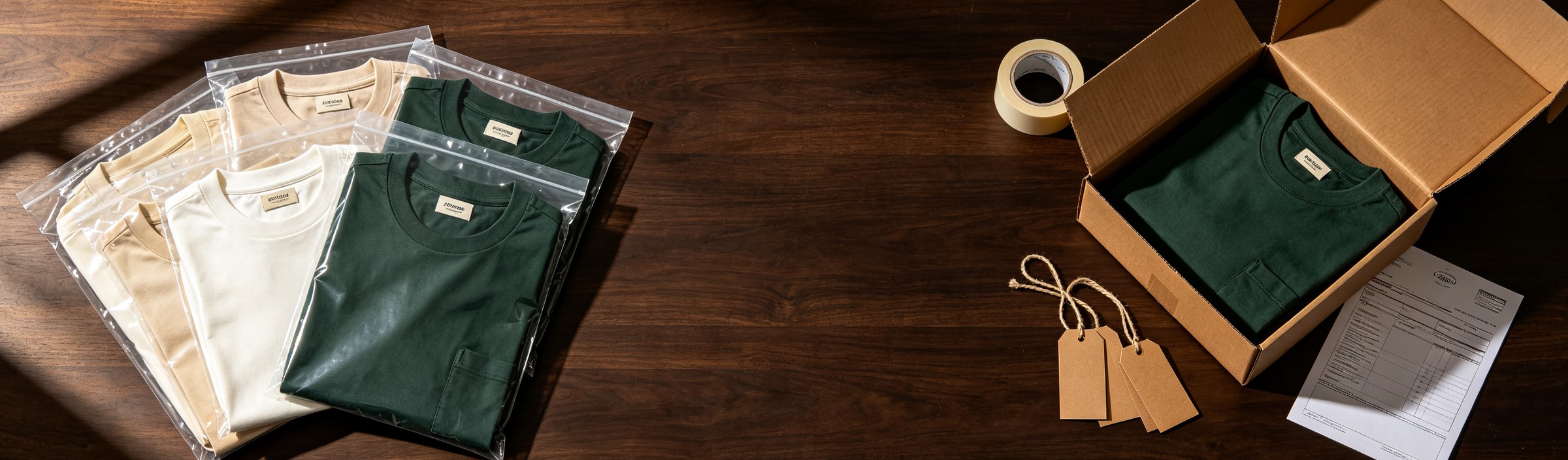
Before anything else, read the byline on whatever guide you are reading. Search “how to start a clothing line” and the results are written, almost without exception, by print-on-demand platforms. Their guides are long, genuinely well made, and free — and they all arrive at the same conclusion, which is that you should use print-on-demand. That is not a conspiracy. It is just what happens when the people answering the question get paid based on your answer.
We are Renrui Textile, a garment factory in Suzhou, China. We are on the other side of that trade: we make money when you place a cut-and-sew order, and we make nothing when you choose print-on-demand. So take everything below with that in mind — and notice that we are going to spend the next section telling you exactly when print-on-demand is the right call anyway, because the numbers say so, and pretending otherwise would waste your money and our time.
What follows is what it actually takes to start a clothing line, written from the factory floor: real costs, real minimums, real timelines, and the line items nobody puts in writing.
What It Actually Costs to Start a Clothing Line: The $50,000 Myth
The figure you will see repeated is that starting a clothing line costs “$2,000 for print-on-demand, or $50,000 and up for cut-and-sew”. That number is not a lie exactly, but it describes a brand launching a full seasonal collection across many styles and colourways, with a designer, a pattern maker and a container.
It is not what a first order costs. Here is the actual arithmetic for a first production run, using our own published FOB prices.
| Cost component (100 units) | Print-on-demand | Cut-and-sew (our FOB) |
|---|---|---|
| Garment | ~$18–24 (blank + print markup) | ~$9–12 (cut-and-sew, your fabric and fit) |
| Decoration (print / embroidery) | included above | $0.80–$2.50 depending on technique |
| Label & packaging | basic tear-away only | $0.35–$0.80 (woven label + polybag + hangtag) |
| Shipping | included (domestic) or per order | ~$2.00–$3.00 / unit sea freight |
| Landed total | $28–38 / unit | $12–18 / unit |
At a $60 retail price, that is the difference between a 40% gross margin and a 75% one. On 100 units it is roughly $1,600 of margin you either keep or hand to a platform. That gap is the entire reason cut-and-sew exists.
So where does $50,000 come from? It comes from doing it at scale, in many styles, all at once. It is not the entry price. The entry price is one style, one or two colours, 100 pieces per colour. At our tee pricing that is somewhere around $90–150 of garments plus a sample. That is the real floor, and almost nobody writing about this will tell you, because almost nobody writing about this is a factory.
When Print-on-Demand Is Genuinely the Right Choice
Here is the part we lose money on. Print-on-demand is the correct decision, and you should not be talking to a factory yet, if any of these is true:
- You have not proven that anyone wants this. If you do not yet have an audience, a waitlist, or a single pre-order, buying 100 pieces of anything is buying inventory to store in your bedroom. POD lets you find out whether the design sells before you spend money making it.
- The graphic is the product. If your brand’s whole differentiation is the artwork on a standard tee, a standard tee is what you need. The blank is not the point. Cut-and-sew would be paying to customise something your customer is not buying you for.
- You want dozens of designs live at once. Testing thirty graphics is a POD workflow. It is not a manufacturing workflow, and any factory that tells you otherwise is quoting you thirty separate development projects.
- Cash flow cannot survive a deposit. Manufacturing means paying before you sell. If that would break you, POD’s pay-as-you-sell model is not a compromise, it is the correct tool.
We are a factory saying this in writing because it saves everyone a wasted month. Roughly a third of the enquiries we get should be print-on-demand orders, and telling them so at the first email is cheaper for us than sampling something that will never reach bulk.
Where print-on-demand stops working
And then, usually somewhere between the second and the tenth month, three things happen at once.
The margin stops. You cannot discount, you cannot run a bundle, you cannot afford wholesale, and you cannot pay for ads — because there is no room in $28–38 of cost against a $60 retail. POD margin does not improve with volume. It is a fixed ceiling, and once you hit it, the only growth left is more traffic at the same thin margin.
The product stops being yours. You cannot change the fabric weight. You cannot change the fit. You cannot move the shoulder seam, use a heavier rib, line the hood, or put your own woven label in the neck. Every competitor printing on the same blank has an identical garment. When a customer says “the quality feels cheap”, you have no lever to pull.
Reorders become the business. The day a style starts selling repeatedly is the day the maths flips, because a repeat cut-and-sew order needs no new sampling — for us it ships in 10–15 days, and the unit cost drops again at 500 pieces.
The honest summary, if you are deciding how to start a clothing line right now: POD is a testing tool. Cut-and-sew is a business model. Use the first to find out what sells, then switch. The mistake is not starting with POD; the mistake is staying on it after it has told you the answer.
What a First Cut-and-Sew Run Actually Costs, Line by Line
These are our published FOB prices at small-batch volume — 100 pieces per colour — and at bulk. Not a range invented for an article; the same numbers we quote.
| Category | Small batch (100 pcs / colour, FOB) | Sample | Bulk (500+ pcs, FOB) |
|---|---|---|---|
| Tank tops | $1.50–$2.30 | $6.50–$10.50 | $0.60–$1.10 |
| T-shirts | $1.80–$3.00 | $8.50–$15 | $0.80–$1.40 |
| Crewneck sweatshirts | $3.80–$5.50 | $11.50–$18.50 | $2.70–$3.50 |
| Pajama sets (knit) | $4.00–$5.50 | — | $2.30–$3.10 |
| Hoodies | $4.80–$6.50 | $11.50–$20 | $2.60–$3.50 |
| Leggings / activewear | $4.80–$7.00 | $16–$23 | $3.00–$4.40 |
On top of the unit price there are exactly three things, and no others:
- A sample fee — the table above. Ours is credited back against your bulk order, which is worth checking anywhere you buy: a factory offering a free sample is making a sales tool, and a factory charging for one is making a garment. Pay for the sample.
- Labels and packaging — $0.35–$0.80 a unit for a woven label, polybag and hangtag. One thing to know before you design a woven label: the loom has a fixed setup, so woven labels have their own minimum, typically 100 per colour. Printed labels go lower. At 100 pieces, plan for that.
- Freight — roughly $2.00–$3.00 a unit by sea at these volumes. Air is faster and several times that.
There are no tooling charges, no setup fees and no plate charges on standard constructions. If a quote contains those, ask what they are for.
So what does the first order really come to?
Take the most common first run we see: one tee style, two colours, 100 pieces each.
100 tees at $1.80–$3.00 is $180–$300. A sample is $8.50–$15, credited back later. Labels and packaging at $0.35–$0.80 adds $35–$80. Sea freight at $2.00–$3.00 adds $200–$300. You are looking at roughly $425–$700 landed, before duty — for a hundred garments that are genuinely yours, in your fabric, with your label in the neck.
That is what it costs to start a clothing line properly, and it is the number the $50,000 figure is hiding. It is not a small amount of money. It is also not a barrier, and it is roughly what a POD brand spends on ads in a fortnight.
The Line Item Nobody Writes About: Duty
Every guide on this topic stops at FOB. Then the goods arrive in the US and the founder discovers that the landed cost is not the quoted cost, and the margin they modelled does not exist.
If you are importing apparel from China to the United States, there are two numbers stacked on top of each other. The MFN base duty, which for most knit apparel sits around 12%. And the current Section 301 rate, which has moved violently and repeatedly, and which no honest factory will print as a fixed percentage on a webpage because it will be wrong by the time you read it.
If you want to see both numbers taken apart on a real order, we did it on a 300-piece hoodie run — FOB against DDP, plus a landed cost calculator you can run on any supplier’s quote: how the two rates stack on an actual invoice.
That is what we do: the duty is quoted as a separate line on the pro-forma, at the rate that actually applies on the day, so the landed cost you model is the landed cost you pay. And if you would rather not touch customs at all on a first import — which for most first-time founders is the right answer — ask for DDP, delivered duties paid, where the goods arrive at your door with duty already inside a single price.
When you compare factory quotes, this is the question that separates them. Most will quote FOB and go quiet about the rest. Ask every one of them: “Will you write the current duty rate into the quote as its own line, and can you ship DDP?”
Start With One Product, Not a Collection
The single most expensive mistake we watch people make when they start a clothing line is launching a collection. Six styles, four colours each, because that is what a brand looks like on Instagram. That is twenty-four separate production runs, twenty-four fit risks, and a warehouse of the twenty-two that did not sell.
Launch one style. Get it right. Let the market tell you the second one.
Two things about minimums that will shape this decision, and they are not the same thing:
- Fabric dyed to your colour: 100 pieces per colour. Each colour needs its own dye run — that is a physical constraint of the dye vat, not a sales policy. But sizes are mixed freely inside those 100. XS to XXL in one go, with no size multiplier. Ask this question specifically, because a lot of factories quote “100” and then require 100 per size, which is a 300-piece order wearing a 100-piece label.
- Colours are counted separately. Each colour needs its own dye run, so the minimum applies per colour — four colours is four times the minimum, not one. A factory offering you four colours inside a single 100-piece order is either selling you blanks or will renegotiate after your deposit clears.
The practical move for a first run: one colour, all sizes. You find out whether the garment sells before you tie up cash in a colour range.
What You Need Before a Factory Can Quote You
You do not need to be a designer, and you do not need software. You need to have made the decisions.
A factory quoting your style is reading for three things, in this order: can we source this, can we sew it at the rate we quoted, and what will we be measured against at inspection. Every question your brief does not answer gets answered anyway — by someone in the factory, quickly, according to what is normal for them rather than what was in your head.
In practice you need one of two things:
A reference garment. Post us something you already own and love. A pattern maker can measure it, feel the fabric and read the construction directly, and it will teach a factory more in ten minutes than forty pages will. Say clearly what you want to keep and what you want to change — “this fit, this weight, 3cm longer in the body, heavier rib” is a brief we can act on today. This is the cheapest, highest-value thing a first-time founder can do, and it costs a courier fee.
Or a tech pack. The specification document: flat sketch, bill of materials with fabric weight and composition, measurements in every size with tolerances, construction written as stitch types rather than adjectives, labels and packaging, and your inspection standard. If that sounds like a lot, it is — and it is also the difference between a quote you can rely on and a quote that moves the moment reality arrives. We wrote the full guide separately, with a free clothing tech pack template you can download without giving anyone your email.
You do not need a perfect one to start a conversation. You do need one before you place an order.
See What a Factory Needs to Quote YouThe Timeline, Honestly
From first email to sellable stock is realistically eight to twelve weeks. Here is where that time actually goes, using our own lead times.
| Stage | Time | What decides it |
|---|---|---|
| Brief & quotation | 2–5 days | A complete brief is quoted fast. An incomplete one becomes a round of questions first — that round is where most of the delay lives. |
| Sampling | 7–10 days | Plus shipping to you, plus your review. Budget for one revision; most styles need one. |
| Bulk production | 25–40 days | After you approve the sample — not after you place the order. |
| Sea freight | 25–35 days | Port to port, plus customs. Air is about a week and several times the cost. |
| Reorder | 10–15 days | No new sampling. Tooling and spec already exist. This is where a factory relationship starts paying. |
Note where the real advantage sits. The first order is slow because everything is being decided for the first time. The second order ships in 10–15 days — which is the entire reason a growing brand stops thinking about unit price and starts thinking about who it manufactures with.
Payment is normally 30% deposit, 70% before shipping, and it should be escrow-protected. Ask.
Before You Send Anyone Your Designs
There is a question underneath this whole process that most founders think but do not ask: you are about to email your complete product design to a factory you have never met, in a country you have never visited. What stops them from making it for someone else?
It deserves a contractual answer rather than a reassuring one. Ask for three things in writing, before you attach a single file:
- An NDA signed before the files move — not after the quote, not with the deposit. A factory that will not sign one before seeing your design has told you something useful for free.
- A no-resale clause in the production contract. This one does more work than the NDA and almost nobody asks for it. It states that your design, patterns and samples are not resold, not listed in the factory’s own catalogue, and not produced for anyone else.
- Ownership of the patterns and tech pack. Your patterns are yours; if you leave, they leave with you. A factory that treats the pattern it graded from your spec as its own property has quietly locked you in, and you will find out on the day you try to move.
We put all three in writing, because it is the question private label buyers ask us more than any other.
Your First 30 Days
Concretely, if you are starting a clothing line from nothing:
- Week 1 — pick one product and one customer. Not a collection. Not “streetwear”. One garment, and a specific person who is already buying something like it and complaining about something specific.
- Week 1 — buy the three garments closest to what you want. Wear them. Wash them. Decide what you would change. This is your brief, and it is worth more than a mood board.
- Week 2 — write the spec. Fabric weight, fit, construction, labels, packaging. Use the tech pack template if you want the structure handed to you.
- Week 2 — email three factories the same brief. Same document, same questions, same day. What comes back tells you more than any directory. Ask each of them: what is your MOQ per colour and is it per size? Is the sample fee credited? Will you write the duty into the quote? Will you sign an NDA before I send files?
- Week 3 — pay for samples. From the two factories that answered best. Yes, both. A second sample costs less than a wrong bulk run.
- Week 4 — sell before you produce. Photograph the sample. Take pre-orders, run a waitlist, post it. Fifty pieces is small enough that pre-orders can genuinely cover it — and if nobody pre-orders a sample they can see, they were not going to buy a hundred of them either.
None of that requires funding, and none of it requires a big order. Starting a clothing line requires asking the questions before production instead of after — and the factories that get annoyed at these questions have told you something useful about themselves, for free.
FAQ: Starting a Clothing Line
A realistic first cut-and-sew order — one style, two colours, 100 pieces each — comes to roughly $425–$700 landed before duty, using our published FOB pricing: $180–$300 for 100 tees, $8.50–$15 for a sample (credited back against bulk), $35–$80 for labels and packaging, and $200–$300 in sea freight. Heavier categories cost more: hoodies run $4.80–$6.50 a piece at 100 pieces per colour rather than $1.80–$3.00. The widely quoted “$50,000 to start cut-and-sew” figure describes launching a full seasonal collection, not a first order.
Start with one product, not a collection, and use a physical reference garment instead of a design. Buy the three garments closest to what you want, decide what you would change, and send one of them to a factory with those notes — a pattern maker can read a real garment far better than a beginner’s sketch. You do not need design software, a degree, or a pattern maker of your own. You do need to have made the decisions: fabric weight, fit, construction, labels, packaging and quantity.
They answer different questions. Print-on-demand is the right tool when you have not yet proved anyone wants the product, when the graphic is the product, or when cash flow cannot survive a deposit — it lets you test without inventory. A manufacturer is right once a style sells repeatedly, because POD margin has a fixed ceiling: about $28–38 landed per hoodie versus $12–18 cut-and-sew at 100 units. POD is a testing tool; cut-and-sew is a business model. The mistake is not starting with POD, it is staying on it after it has told you the answer.
For fabric dyed to your colour, 100 pieces per colour is the practical floor — each colour needs its own dye run. Ask two things specifically: are sizes mixed freely inside those 100 (ours are, with no size multiplier — a lot of factories quote 100 and then require 100 per size), and is the minimum counted per colour or per style (ours is per colour, because each colour needs its own dye run — so plan a single colour for a first run). Be wary of “no minimum”, which usually means relabelled stock garments rather than production.
Not to start a conversation, but you need one before you place an order. A factory quoting without a spec is quoting its own assumptions — usually the cheapest reasonable interpretation of what you described — and that number moves once the real spec appears. If you do not have a tech pack, send a physical reference garment and a target price instead; that is a better starting point than a description.
Eight to twelve weeks from first email to sellable stock: a few days to quote, 7–10 days for a sample plus your review and usually one revision, 25–40 days of bulk production after you approve the sample, then 25–35 days of sea freight. Reorders are the payoff — with the spec and tooling already in place they ship in 10–15 days with no new sampling.
Duty, and it is the line item most guides stop short of. For apparel entering the US there is an MFN base rate — around 12% on most knit apparel — plus the current Section 301 rate, which moves too often for anyone to print honestly on a webpage. What matters is whether the factory will write the applicable rate into the quote as its own line, calculated on the day you order, so your landed cost is real. On a first import, DDP (delivered duties paid, to your door) removes customs from your problem entirely. Ask for both.
Where to Go From Here
If you have a reference garment and a rough quantity, you already have enough to get a real quote. It costs nothing, it settles fabric, price tier and timeline in one exchange, and the way a factory answers the questions in this article will tell you more about it than its website will.
We manufacture knitwear and home textiles from our own factory in Suzhou and work with brands from 100 pieces up, which means most people who write to us are placing their first order ever. The categories we run most often are small-batch apparel production, first orders for new brands, hoodies and heavyweight fleece, tees, women’s knitwear and sleepwear and loungewear.
✅ From 100 pcs per colour — sizes mixed freely, no size multiplier
✅ Published FOB pricing — the tables above are what we quote
✅ Duty written into the quote as its own line, or DDP to your door
✅ Sample in 7–10 days, fee credited against your bulk order
✅ NDA before you send files — plus a no-resale clause and pattern ownership in writing
✅ AQL 2.5 — bulk that deviates from your approved sample is remade
⏱️ We reply to every inquiry within 8–12 hours. [email protected] · WhatsApp +86 133 7216 9755