
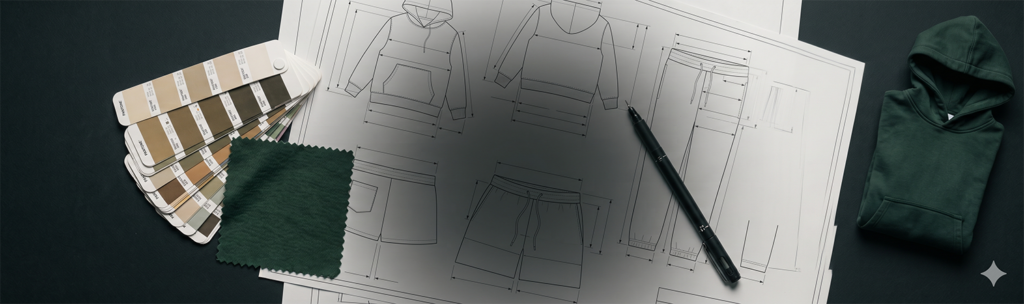
Here is what actually happens when a new brand reaches out to a garment factory for the first time: the brand asks for an OEM quote, the factory assumes the brand is bringing a complete tech pack, and the brand is expecting the factory to show them options. Neither side realizes the disconnect until three emails in, at which point both parties are frustrated and the relationship is already on uncertain ground.
The terms OEM, ODM, and private label are used constantly in the apparel industry — and used almost as interchangeably. That slippage costs real time. A factory quoting for OEM work and a brand expecting ODM flexibility are going to have a genuinely confusing first conversation. This article is here to fix that before it costs you anything.
OEM Defined — From the Factory's Perspective
OEM stands for Original Equipment Manufacturer. The name sounds like it refers to the product, but from an OEM apparel manufacturer’s standpoint, the logic runs the other way: you bring the design, we manufacture it. That is the full definition. The factory provides the equipment, the labor, and the production capability. The design comes entirely from you.
The word “original” in OEM refers to the equipment — the factory, its machines, its workforce — not the product. The design originates with the brand. Once produced, the factory holds no intellectual property rights to what they’ve made. They cannot sell that design to another buyer. They do not own the colorway, the construction detail, the pattern. They built it to your specification and their involvement in it ends there.
In practice this means: if you bring a factory a tech pack for a cut-and-sew fleece hoodie with specific seam construction, a particular weight of brushed French terry, and your branded hardware — that factory is operating as your OEM manufacturer. They are not your design partner. They are your production partner.
This distinction matters because it defines what you can reasonably expect from them. An OEM manufacturer will quote based on your specifications. They will flag construction issues. They will source materials against your fabric call-out. They will not redesign the garment. They will not suggest a different fit direction. That is not their role in an OEM relationship.
ODM: When the Factory Owns the Design
ODM stands for Original Design Manufacturer. The relationship inverts: the factory designed the product, and you’re selecting from their existing range to sell under your own brand. The factory retains the IP. You’re licensing use of the design, in a sense, by placing your order.
The practical advantages are real. Getting to market faster is the obvious one — there is no development phase because the product already exists. Sampling is faster. Costs are lower because the factory has already amortized the design work across many buyers. For brands that want to test a category before committing to full development, ODM is a legitimate shortcut.
The limitation is equally real, and it is specific: your competitor can order the same garment from the same factory. This is not a hypothetical. It is the standard business model for ODM manufacturers. A windbreaker sitting in a factory’s ODM catalog is available to any brand that sends an inquiry. The only differentiator you have is your label and your marketing.
That is fine for some purposes. If you are testing whether a particular product category resonates with your audience before investing in original development, ODM risk is manageable. If you are trying to build a product that your competitors cannot copy, ODM is structurally incompatible with that goal. The product was designed to be replicated.
Private Label: Where OEM and Branding Overlap
Private label is not a manufacturing method. This is the misunderstanding that causes the most confusion in brand-factory conversations. Private label describes a branding arrangement, not a production model. It means the finished product carries your brand, not the manufacturer’s.
You can do OEM manufacturing and private label simultaneously. You bring the design (OEM), the factory builds it, and the finished garment ships with your label and your hangtags (private label). Most branded apparel works exactly this way. Nike does not manufacture its own garments. The factories that produce Nike products are operating as OEM manufacturers. The branding is private label.
The confusion arises because “private label” is sometimes used loosely to mean ODM-with-your-label — a factory’s existing design, rebranded for your store. This is technically private label ODM, and it is common in wholesale and retail contexts. When a factory says “we offer private label services,” they may mean either OEM production for your designs or their own designs with your branding applied. Always ask which one. The answer changes what you need to bring to the table.
For practical purposes: if a factory asks whether you want “private label,” ask them directly — do they mean you bring the design, or they provide it? That one clarifying question eliminates a significant amount of downstream confusion.
See Our Private Label ProgramThe Tech Pack — What OEM Manufacturers Actually Need From You
This is where most new brands lose time. Not in finding factories, not in negotiating price — in the gap between what a brand brings to a factory and what an OEM manufacturer actually needs to begin meaningful work.
A complete tech pack is the foundational document for OEM production. It tells the factory everything they need to know to build your garment without guessing. Here is what it includes:
Flat sketch (front, back, detail views)
Technical illustration showing the garment’s construction. Not a fashion sketch — a flat drawing that shows seam placement, pocket construction, hardware positioning, and any design details that affect pattern-making. CAD or hand-drawn, as long as it is dimensionally accurate.
Size spec sheet
Measurements for every size in your run, listed by measurement point (chest, length, sleeve, hem, etc.). Specify whether measurements are taken on the body or on the garment. Include grading increments so the factory can construct the full size range from your base size.
Construction notes
Seam type (flatlock, overlock, bound), stitch count per inch, topstitch placement, hardware specifications (zipper brand or specification, snap dimensions, eyelet material and finish). If any construction detail is non-negotiable, flag it here.
Fabric specification
Fiber composition, fabric weight (GSM), weave or knit structure, finish (brushed, enzyme-washed, DWR-coated), and stretch percentage if applicable. Provide a swatch if you have one, and note whether this fabric spec is fixed or whether the factory may suggest alternatives.
Colorway with Pantone references
Pantone TPX or TCX numbers for each color. If you are matching an existing physical sample, include the sample. “Navy” without a Pantone reference will produce a different result from every factory you send it to.
Label and packaging requirements
Care label placement and content, main label dimensions and attachment method, hangtag specs, polybag folding and labeling requirements, carton marking. If you have brand guidelines, attach them or specify which elements apply to packaging.
Brands that have never worked with a factory often assume the tech pack comes first and the sample comes second. In practice, for first-time OEM buyers, the sequence is often: reference garment plus rough measurements plus fabric direction first, sampling second, and a formalized tech pack built from the approved sample. The sample IS the tech pack for many small-batch brands starting out.
What you cannot do without, at any stage, is Pantone references and a clear fabric specification. Color and fabric are the two areas where vague language produces the most expensive mistakes, because fixing them usually means re-sampling.
How to Structure Your First OEM Inquiry
The quality of your first message to a factory sets the tone for the entire relationship. A vague inquiry produces a vague response — or no response. A specific inquiry signals that you are a serious buyer and that the factory’s time will be well spent.
Include these five elements in your first message:
-
Product category and quantity — even if approximate. “I’m looking to produce men’s cut-and-sew fleece hoodies, targeting 300–500 units per colorway for the first order.” This tells the factory whether you are a fit for their MOQ structure and production capabilities before anyone spends time on detailed discussion.
-
Your target fabric, or a request for recommendation. “I’m targeting a 400GSM brushed French terry in 80% cotton / 20% polyester. If you have alternative fabric options in that weight range, I’m open to seeing them.” Giving the factory a fabric direction, even a provisional one, allows them to check material availability and give you a more useful initial response.
-
What you are bringing to the table: tech pack, reference sample, or sketches only. “I have a reference garment and measurements but not a formalized tech pack yet” is entirely acceptable and honest. It lets the factory tell you what they can work with at this stage. Do not overstate your readiness — it wastes everyone’s time.
-
Your sampling timeline. “I’m hoping to have samples in hand within 8–10 weeks” gives the factory context for whether your timeline is workable and flags any scheduling constraints on their side early in the conversation.
-
Your target bulk delivery window. “I’m targeting a bulk delivery in Q4 of this year” allows the factory to assess their capacity and flag any concerns about the timeline before sampling begins.
A note on what to watch for in factory responses: a serious OEM manufacturer will ask clarifying questions before quoting. They will want to know more about your fabric spec. They will ask whether you have a reference for the construction. They may push back on your timeline if it is tight. This is what a capable factory does — they are trying to understand the job before they price it.
If a factory responds to your first inquiry with a price per unit before asking a single clarifying question, treat that as a signal. Either they are quoting generic production costs without understanding your actual garment, or they are quoting for something you did not ask for. Either way, the foundation of the relationship is already inaccurate.
OEM vs. ODM vs. Private Label — Summary Table
The distinctions between these three terms collapse in casual use and sharpen when it matters — usually when something goes wrong. This table puts the key differences in one place.
| Factor | OEM | ODM | Private Label |
|---|---|---|---|
| Design ownership | Brand owns design | Factory owns design | Depends on OEM or ODM basis |
| Exclusivity | Exclusive to your brand | Available to any buyer | Only if built on OEM |
| IP control | Full — you hold the IP | None — factory holds IP | Branding only, not product |
| Development cost | Higher | Lower | Varies |
| Time to market | Longer | Faster | Varies |
| What you bring | Tech pack / full specification | Branding, label, quantity | Your brand identity |
| Best for | Brands building differentiated, proprietary products | Category testing; speed-to-market priorities | Branding strategy — not a production model |
The right choice depends on what you are trying to accomplish. If you are testing a new category and time-to-market is the priority, ODM is a rational starting point. If you are building a product line that your competitors should not be able to replicate, OEM is the only model that gives you structural protection. Private label, as a branding approach, can be layered on top of either.
Getting clear on these distinctions before your first factory conversation does not just save you time — it changes the quality of the conversation entirely. You show up as a buyer who understands the work, which changes how factories engage with you. Most sourcing problems do not start in production. They start in the first conversation, when terms are used loosely and expectations are set incorrectly.
If you are at the early stage of building your brand and quantity is a constraint, the manufacturing model you choose will also affect your options. Read our guide to working with a low MOQ clothing manufacturer — including what to expect at smaller quantities and how to structure sampling when you are not yet buying at scale.
Looking for a Low MOQ Clothing Manufacturer?
Why Request a Quote From Us
- ✅ Low MOQ — flexible for new brands & small batches
- ✅ OEKO-TEX® Standard 100 & GRS 4.0 certified materials
- ✅ Full OEM / ODM — your design, labels & packaging
- ✅ Sample turnaround in 7–10 days
- ✅ Free fabric swatch pack on request
What to Include in Your Inquiry
- Styles & target quantity
- Material / fabric preference
- Custom logo & labeling needs
- Target price & deadline
⏱️ We reply to every inquiry within 8–12 hours.
You can also reach us directly:
WhatsApp: +86 13372169755
E-mail: [email protected]