The real question is not which filling is "better." It is which construction keeps either one from sliding to the corners after the twentieth wash — and that is the part every blog post about this topic skips, because it is not a filling question. It is a factory question.
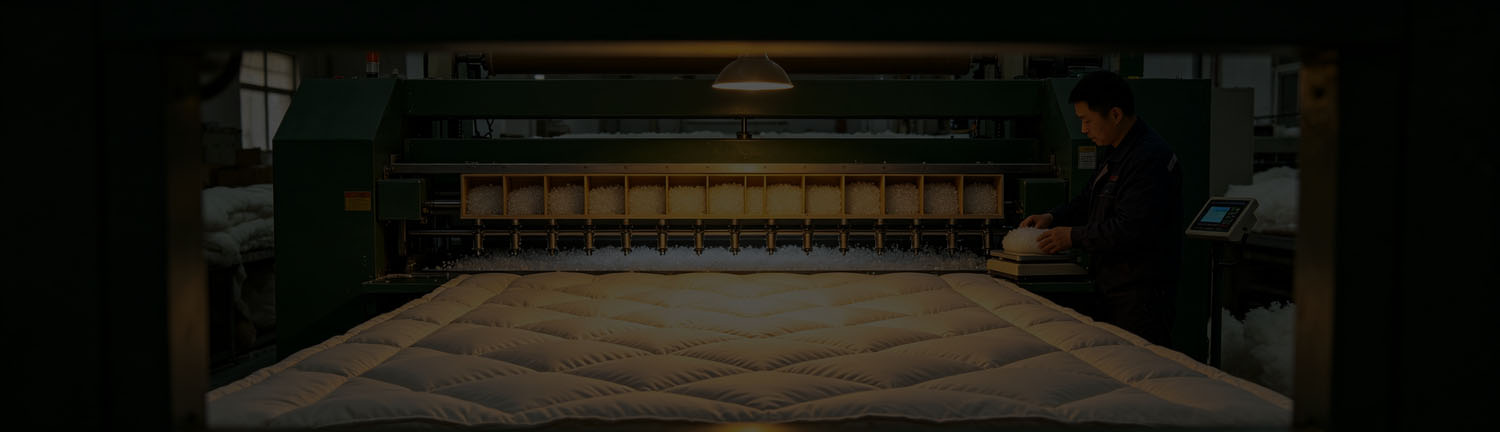
We are Renrui Textile, a home textile OEM manufacturer in Suzhou, China. We run glass beads and poly pellets side by side on the same quilting lines, and the choice between them matters less than most people think. What matters more — and what this page will explain with specifics — is the stitch pattern holding them in place.
There is a free spec sheet at the bottom. Excel and PDF, no email required.
The Real Difference Between Glass Beads and Poly Pellets
You will see “glass beads are 2x denser than poly pellets” repeated everywhere online. We looked for a single source that actually measured it and could not find one — so we will not repeat it as fact. What we can tell you from running both on the same production floor: beads let us build a slimmer panel for the same target weight.
| Glass Micro-Beads | Poly Pellets | |
|---|---|---|
| Feel / size | Fine, sand-like grain | Larger, pea-sized pellet |
| Weight-to-volume | Noticeably denser — same weight fits a thinner, less bulky panel | Lower density — needs more volume for the same weight |
| Noise | Silent | Can have a faint rustle when the blanket is shaken |
| Wash care | More sensitive to repeated tumble-dry heat over years | More heat-tolerant, more forgiving on care labels |
| Typical use case | Premium / slim-profile lines, adult retail | Kids’ lines, budget / heavier-use lines |
Both materials are available across our weighted blanket OEM line. Both carry OEKO-TEX Standard 100 and GRS 4.0 certified shell fabric options. Neither choice locks you out of a certification requirement.
What Actually Stops the Fill from Shifting (It Is Not the Material)
Both fillings shift if the panel is too big. That is a stitching decision, not a filling decision — and it is the part every comparison article skips because it cannot be judged by reading a spec sheet online. It has to be built.
Baffle-Box Construction
Baffle-box construction stitches internal fabric walls that form small 3D pockets — the fill can move slightly within its own box but cannot migrate to a neighboring section or pool at one edge. It costs more machine time and more fabric (the internal walls use extra yardage), which is why most DTC brands do not offer it: they buy finished goods off a shared production line and cannot control the construction.
Channel-Stitch Construction
Channel-stitch construction sews straight-line channels instead of boxes. Faster to produce, lower cost, and still keeps the fill from sliding end-to-end — the tradeoff is the fill can settle slightly lengthwise within its channel over time, which shows up as a firmer strip near the bottom edge after months of use.
We run both. Baffle-box for lines positioned on even weight distribution as the selling point; channel-stitch for price-competitive lines where the channel settling is an acceptable tradeoff. Either way, every unit gets weighed before it ships — not sampled, checked — so the spec you approved on the sample is the spec that ships, regardless of which construction you pick. Fill weight is verified within ±3% per unit, in addition to our standard 3-point in-line QC to AQL 2.5.
How Heavy Should a Weighted Blanket Be? (Weight Chart)
The widely cited guideline — used by the Sleep Foundation and most manufacturers — is 10% of body weight, with a comfortable range of 5–12%. This is not a hard rule (individual preference varies), but it is a reliable starting point for product development. Below is the full weight-to-body chart, included in the free download at the bottom of this page.
| Body Weight | Suggested Fill Weight (10%) | Common Retail Range |
|---|---|---|
| 100–120 lbs | 10–12 lbs | 10 lb |
| 130–150 lbs | 13–15 lbs | 15 lb |
| 160–180 lbs | 16–18 lbs | 15–20 lb |
| 190–220 lbs | 19–22 lbs | 20 lb |
| 230+ lbs | 23+ lbs (practical ceiling ~25–30 lb) | 25 lb |
| Kids (3+ yrs, 50+ lbs) | 10% of body weight + 1 lb | 5–10 lb |
| Couples sharing one blanket | 7.5% of combined body weight | — |
Safety note: Weighted blankets are generally recommended for children aged 3 and older who weigh at least 50 pounds. For therapeutic or medical use, confirm the target fill weight with a healthcare provider. These numbers are product-development guidelines, not medical advice.
See Our Weighted Blanket ManufacturingFill Weight + Material Spec Sheet
Two-page reference: the full body-weight-to-fill chart on page one, plus a side-by-side glass beads vs poly pellets comparison and baffle-box vs channel-stitch spec guide on page two. Use it for your own product specs, share it with your team, print it for a buying meeting. No attribution needed, no form to fill in.
Download the Excel spreadsheet Download the printable PDF
Want us to quote your spec? Send us your filled-in target weights and we will quote your MOQ the same business day — send us your target weights for a same-day quote.
Frequently Asked Questions
Neither is objectively better — they serve different product positions.
Glass beads are denser and silent, making them the default choice for premium adult lines where a slimmer panel and zero noise matter. Poly pellets are more heat-tolerant on the care label and more forgiving of repeated machine drying, which suits kids’ lines and budget price points.
The factor that matters more than the material choice is the stitch construction holding either fill in place — without baffle-box or tight channel quilting, both materials will migrate toward the edges over repeat use. We run both materials on the same production lines, and the construction spec is the decision that determines whether the blanket holds its shape after a year, not the fill type.
The stitch construction, not the fill material.
Baffle-box construction sews internal fabric walls that create small 3D pockets — the fill stays locked within its own box and cannot migrate to neighboring sections.
Channel-stitch construction uses straight-line stitched channels that keep the fill from sliding end-to-end, though minor settling within the channel is possible over months of use.
Baffle-box costs more in machine time and fabric but delivers the most even long-term distribution; channel-stitch is faster and more cost-effective. We offer both and confirm your choice at quoting based on your target retail position.
The widely cited industry guideline is 10% of body weight, with a comfortable range of 5–12%. A 150 lb person would target a 15 lb blanket; a 200 lb person would target 20 lb.
For children aged 3+ who weigh at least 50 lbs, the guideline is 10% of body weight plus one pound. For couples sharing a single blanket, target roughly 7.5% of combined body weight.
These are product-development starting points, not medical recommendations — individual preference varies. The full weight chart is in the free spec sheet on this page.
Weighted blankets are generally considered safe for children aged 3 years and older who weigh at least 50 pounds. The fill weight for children is typically 10% of body weight plus one pound.
A child should be able to remove the blanket independently. For therapeutic or sensory use, confirm the target weight and construction with a healthcare provider — the guidelines above are product-development references, not medical advice.
Every unit we produce is individually weighed before packing and checked within ±3% of its stated weight. This is not a batch sample — it is per-unit verification, in addition to our standard 3-point in-line QC to AQL 2.5.
We check every piece for weight specifically because an inaccurate weighted blanket is the product failing at its one job.